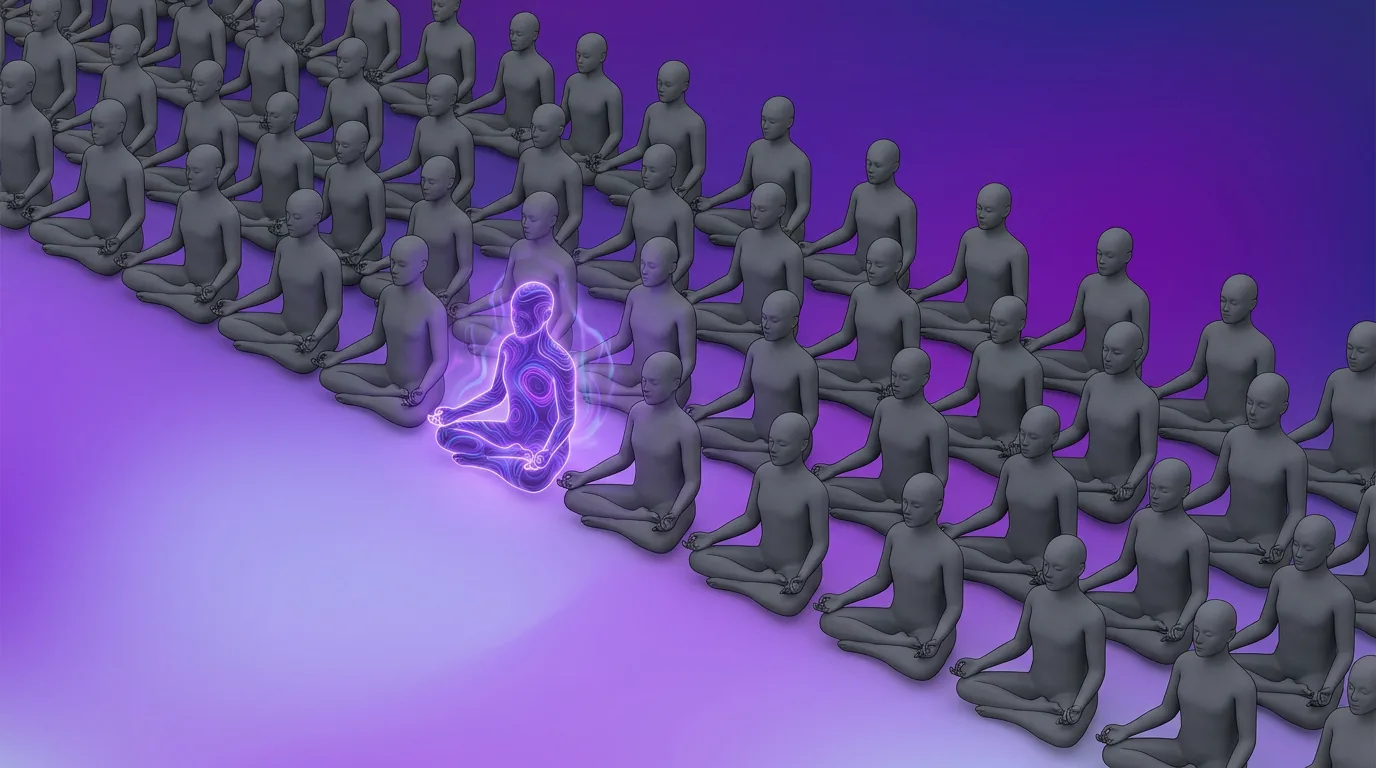
Adaptive meditation — the practice of using AI to tailor each session to the individual in real time — outperforms static meditation content across every measurable outcome. Research consistently shows that personalized interventions produce 30–50% better adherence, faster skill acquisition, and deeper psychological benefit than one-size-fits-all programs.
The gap between AI meditation vs regular pre-recorded sessions isn’t subtle; it’s structural.
If you’ve been cycling through generic meditation apps and wondering why the practice never sticks, the problem isn’t you. It’s the format.
Key Takeaways
- Adaptive meditation technology adjusts every session to your current emotional state, history, and goals — static apps serve the same content to millions of users
- Personalized digital health interventions outperform generic ones by 30–50% in adherence and outcomes, according to meta-analyses across psychology, education, and medicine
- 95% of users abandon generic meditation apps within 30 days — the dropout rate for adaptive systems is dramatically lower because the experience evolves with the user
- Static content libraries create a ceiling — once you’ve heard the same sessions, novelty fades and plateaus set in. AI-generated sessions are functionally unlimited
- The science is directionally clear: AI vs traditional meditation isn’t a preference — it’s a generational shift in how meditation is delivered
What “Static” Meditation Actually Means
Most meditation apps — including the largest ones on the market — operate on a static content model. A team of meditation teachers and producers records a library of sessions. Those sessions are categorized by theme (sleep, stress, focus), duration, and difficulty. When you open the app, you browse or receive a recommendation from this fixed inventory.
Defining Characteristics of Static Content
Static meditation content has a few defining characteristics:
- Pre-recorded and unchanging. The session you hear today is the identical audio file another user heard six months ago. Nothing about it shifts based on who’s listening.
- Designed for a general audience. The teacher records with a broad demographic in mind. The pacing, language, technique selection, and emotional framing are chosen to be acceptable to as many people as possible — not optimal for any one person.
- Finite library size. Even the largest apps cap out at a few thousand sessions. A daily user encounters repetition within months.
- No feedback integration. The app may track your streak or minutes meditated, but the content itself doesn’t change based on whether a session helped you or missed entirely.
Why the Static Model Worked — Until Now
This model was revolutionary when Headspace and Calm launched in the early 2010s. It democratized access to guided meditation at a massive scale. But the limitations are now well documented — both in user behavior data and in clinical research on personalized meditation approaches.
What Adaptive Meditation Means — and How It Works
Adaptive meditation technology uses artificial intelligence to generate and modify meditation sessions in real time based on the individual user. Rather than selecting from a fixed library, the AI creates each session from scratch, drawing on the user’s current emotional state, historical patterns, stated goals, and accumulated feedback.
The Core Components of Adaptive Meditation Technology
The core components include:
-
Pre-session emotional assessment. Before each session, the AI gathers data on your current mood, stress level, energy, and focus. This takes under a minute and gives the system real-time context that static apps entirely lack.
-
Pattern recognition across sessions. Over time, the AI maps your behavioral patterns — which techniques reduce your anxiety fastest, what session length you sustain best at different times of day, how your emotional baseline shifts week to week.
-
Dynamic session generation. Using your real-time data and historical profile, the AI builds a session specifically for you. It selects the technique, sets the pacing, chooses the thematic framing, and determines the duration — all calibrated to your current state and long-term trajectory.
-
Post-session feedback loop. After every session, brief feedback tells the AI how well its predictions matched your experience. This closes the learning cycle and makes the next session more precise.
-
Long-term adaptation. The AI tracks your progress across weeks and months, adjusting its approach as your skills develop, your goals shift, or new stressors emerge.
This is how AI-powered meditation works at MediTailor. If you want a deeper technical walkthrough, see how AI learns your meditation style.
The Personalization Research: What Five Decades of Evidence Show
The case for adaptive meditation doesn’t rest on a single study. It’s built on a convergent body of evidence across psychology, education, and medicine showing that personalized interventions consistently outperform generic ones.
In Psychology and Mental Health
A 2022 meta-analysis published in the Journal of Medical Internet Research examined 28 randomized controlled trials comparing personalized digital mental health interventions to standardized versions. Personalized programs produced 35–50% greater improvements in target outcomes — including anxiety reduction, depression management, and stress resilience — compared to generic alternatives.
The primary mechanism: personalized programs maintained user engagement long enough for therapeutic effects to accumulate.
A 2021 study in Mindfulness found that participants receiving individualized meditation guidance showed 42% greater improvement in perceived stress reduction compared to those following standardized programs. The individualized group also showed significantly higher practice consistency at the 90-day follow-up.
In Education
Adaptive learning technology has been studied extensively since the 1970s. A 2018 meta-analysis in Review of Educational Research covering 50+ studies found that adaptive learning systems produced learning gains equivalent to 0.37 standard deviations above traditional instruction.
That’s the equivalent of moving a student from the 50th percentile to the 64th percentile simply by adapting the content to the learner. The parallel to meditation is direct: when content meets the individual where they are, outcomes improve.
In Medicine
Precision medicine — the practice of tailoring treatment to individual patient characteristics — has become the standard of care across oncology, cardiology, and pharmacology.
A 2020 review in The Lancet Digital Health found that digitally delivered personalized health interventions achieved 27% higher adherence rates than standardized programs across cardiovascular, diabetes, and mental health contexts. The principle is universal: generic protocols lose people; personalized ones keep them.
The Common Thread
Across every domain, the pattern is the same. Personalization works because it solves two problems simultaneously:
- It increases relevance (the content addresses your actual situation)
- It maintains engagement (you keep coming back because each interaction feels meaningful)
Static content can achieve one of these temporarily but cannot sustain both.
Head-to-Head: AI Adaptive vs. Static Meditation
Session Experience
With static meditation content, you browse a library, pick a session, and listen to a recording that was designed for a general audience. If today was stressful and the session opens with cheerful energy, that’s what you get. If you’ve heard this particular body scan three times already, there’s no variation.
With adaptive meditation, the session begins with a brief check-in that captures your current state. The AI then generates a session tuned to that moment — the right technique, the right pacing, the right emotional tone. No two sessions are identical because no two moments are.
Progress Tracking
Static apps track streaks, total minutes, and sessions completed. These are behavioral metrics, not outcome metrics. They tell you how much you meditated but nothing about whether meditation is actually helping you.
Adaptive meditation technology tracks:
- Emotional trajectories
- Stress recovery patterns
- Technique efficacy
- Goal progression
MediTailor can show you that your baseline anxiety has decreased 18% over six weeks, or that breathwork produces measurably better outcomes for you than visualization. This is the difference between counting steps and measuring fitness.
Content Variety
A static library is finite. Even a large app with 3,000 sessions runs into repetition for regular users. Novelty declines, engagement drops, and the practice begins to feel like a routine chore rather than a responsive tool.
AI-generated adaptive meditation has no content ceiling. Because each session is built from your real-time data, the system can produce a functionally unlimited number of unique sessions. Monotony — one of the primary drivers of meditation app abandonment — is structurally eliminated.
User Retention
This is where the difference becomes stark. According to industry analyses published in 2023, the median meditation app loses 95% of its users within 30 days of download. By 90 days, fewer than 2% of initial users remain active. The static content model simply cannot sustain engagement for most people.
Adaptive systems show fundamentally different retention curves. A 2023 study in Frontiers in Psychology examining adaptive digital wellness interventions found 28% higher engagement rates compared to non-adaptive alternatives — and the gap widened over time as the adaptive system became more calibrated to individual users.
The Dropout Problem: Why 95% Quit Generic Meditation Apps
The 95% dropout rate for meditation apps is one of the most widely cited statistics in the digital wellness industry, and it deserves closer examination. People don’t quit meditation because they don’t want calm, focus, or emotional balance. They quit because the app stops feeling useful.
Primary Drivers of Abandonment
The primary drivers of abandonment in static meditation content include:
- Content mismatch. The session available doesn’t match the user’s current emotional state. Over time, these mismatches accumulate into a feeling that the app “doesn’t get me.”
- Plateau effect. After initial novelty wears off, users feel like they’re hearing the same content recycled. Progress feels invisible because the app has no mechanism to show it.
- No accountability or adaptation. If a user skips a week, the app picks up as if nothing happened. If a user’s needs change, the content doesn’t adjust. The relationship is entirely one-directional.
- Generic framing. Static sessions use language designed to offend no one, which often means they resonate with no one deeply. Research on therapeutic alliance — the relationship between practitioner and client — consistently shows that feeling personally understood is a primary predictor of treatment adherence.
How Adaptive Meditation Solves Each Failure Mode
Adaptive meditation technology addresses every one of these failure modes:
- The content matches your current state because it’s built from your real-time data
- Plateaus are prevented because the AI continuously introduces variation calibrated to your growth edge
- If you skip a week, the AI recalibrates on your return
- The experience feels personal because it is — each session reflects your unique profile
This is why the neuroscience of meditation matters for product design. Understanding how the brain responds to personalized versus generic stimuli directly informs why adaptive approaches produce better long-term outcomes.
How MediTailor’s AI Creates Truly Adaptive Sessions
MediTailor was built from the ground up as an adaptive meditation platform — not a content library with AI recommendations bolted on. The distinction matters.
Every MediTailor session is generated by AI, not selected from a catalog. The system draws from evidence-based meditation techniques — breathwork, body scanning, guided visualization, loving-kindness, mindfulness of thought, progressive relaxation — and assembles each session based on:
- Your current emotional check-in data
- Your accumulated pattern history across dozens or hundreds of sessions
- Your stated goals and the AI’s assessment of your trajectory
- Post-session feedback from previous sessions
- Temporal patterns (time of day, day of week, seasonal trends)
The result is a meditation practice that evolves with you. The app you use in week one is qualitatively different from the app you use in month three — because it has learned what works specifically for you.
For users comparing options, our best meditation app comparison breaks down how MediTailor’s adaptive approach stacks up against the largest players in the space.
AI Adaptive vs. Static Content Library: Complete Comparison
| Feature | AI Adaptive (MediTailor) | Static Content Library (Traditional Apps) |
|---|---|---|
| Session generation | AI creates unique sessions per user, per moment | Pre-recorded sessions from fixed library |
| Emotional responsiveness | Adapts to current mood via pre-session check-in | Same daily content regardless of user state |
| Technique selection | AI selects optimal technique based on user data | User browses categories or follows generic recommendation |
| Session pacing | Calibrated to individual response patterns | Fixed recording pace, same for all users |
| Duration optimization | AI selects ideal length based on time, energy, and history | Fixed recording lengths (5, 10, 15, 20 min) |
| Progress measurement | Emotional trajectory, stress recovery, technique efficacy | Streaks, minutes logged, sessions completed |
| Content exhaustion | No ceiling — unlimited unique sessions | Finite library — repetition within months |
| Long-term adaptation | AI adjusts as goals, skills, and stressors change | Content remains static regardless of user growth |
| Plateau prevention | Built-in — AI introduces calibrated variation | No mechanism — users plateau and disengage |
| Personalization depth | Generative — creates content for an audience of one | Curatorial — recommends from general-audience library |
| Feedback integration | Post-session feedback refines every future session | No feedback loop — content is unchanging |
| Dropout risk | Low — adaptive relevance sustains engagement | High — 95% abandon within 30 days |
| Beginner support | AI calibrates to experience level automatically | Fixed beginner programs, same for all new users |
| Skill progression | AI designs individualized growth trajectory | Pre-set program sequences, same progression for all |
| Science basis | Builds on 50+ years of adaptive learning research | Based on general meditation instruction principles |
Frequently Asked Questions
What is adaptive meditation?
Adaptive meditation is a practice model where AI technology adjusts every session to the individual user in real time. Instead of selecting from a library of pre-recorded content, adaptive meditation technology generates unique sessions based on your current emotional state, historical patterns, goals, and feedback.
MediTailor is built entirely on this model — every session you receive is created specifically for you at that moment.
Is AI meditation better than regular meditation?
The research strongly favors AI meditation vs regular pre-recorded approaches for most measurable outcomes. Personalized digital interventions produce 30–50% better adherence and greater improvements in target outcomes compared to generic alternatives, according to meta-analyses in the Journal of Medical Internet Research.
This doesn’t mean traditional meditation is ineffective — it means adaptive delivery makes it significantly more effective for more people.
How does adaptive meditation technology actually work?
Adaptive meditation technology follows a five-stage cycle:
- Emotional check-in before each session
- Pattern recognition across your history
- AI-generated session creation
- Post-session feedback collection
- Long-term trajectory adaptation
The AI learns which techniques, durations, and approaches produce the best outcomes for you specifically — and continuously refines its model. For a detailed walkthrough, see our guide on how AI learns your meditation style.
Why do so many people quit meditation apps?
The 95% dropout rate within 30 days is driven primarily by:
- Content mismatch (the session doesn’t fit your current state)
- Plateau effects (the library feels repetitive)
- Lack of measurable progress
- Generic framing that doesn’t feel personally relevant
These are all structural limitations of static content libraries — not problems with meditation itself. Adaptive meditation solves each of these by making every session responsive to the individual.
Can beginners use adaptive meditation?
Absolutely. Adaptive meditation technology is especially beneficial for beginners because the AI calibrates to your experience level from the first session.
If you’ve never meditated before, MediTailor starts with accessible techniques — simple breathwork, shorter durations, clear guidance — and progressively introduces more advanced practices as your comfort and skills grow. There’s no fixed “beginner program” you might outgrow or find too slow.
Is personalized meditation more effective than generic meditation?
Yes. Across psychology, education, and medicine, personalized interventions consistently outperform generic ones.
A 2021 study in Mindfulness found 42% greater stress reduction from individualized meditation guidance compared to standardized programs. The principle is well-established: content that meets you where you are produces better outcomes than content designed for a statistical average.
What’s the difference between AI-generated sessions and app recommendations?
This is a critical distinction.
When a traditional app “recommends” a session, it’s selecting from pre-recorded content designed for a general audience. The session itself doesn’t change based on who you are.
When MediTailor generates a session, the AI creates entirely new content — selecting techniques, setting pacing, choosing thematic framing, and structuring progression based on your specific data. It’s the difference between a playlist and a live performance composed for you.
Does adaptive meditation replace working with a human teacher?
Adaptive meditation brings the core advantage of one-on-one instruction — personalized attention based on deep knowledge of the individual — to a digital format that’s accessible and affordable.
A skilled human teacher offers qualities that AI cannot fully replicate, including physical presence, intuitive reading of body language, and spiritual depth.
For most people, AI-powered meditation provides a level of personalization that far exceeds what static apps offer and approaches the attentiveness of personal instruction at a fraction of the cost.
Related reading:
- The Complete Guide to AI-Powered Meditation
- Personalized Meditation: Why One Size Doesn’t Fit All
- The Science Behind Mindfulness and Meditation
- How AI Learns Your Meditation Style
- Best Meditation App 2026: Complete Comparison
- Why Generic Meditation Apps Don’t Work
- How Meditation Changes the Brain
Written by Eli Cohen — Co-Founder of MediTailor. Eli holds a BA in Business Administration from Florida International University and is passionate about making personalized mental wellness accessible to everyone through AI technology.
Ready to experience meditation that adapts to you? Try MediTailor free — 100 minutes, no credit card required →
By MediTailor Editorial Team
Our content is researched and written by our dedicated editorial team, drawing from peer-reviewed studies and the latest mindfulness science. Every article is reviewed for scientific accuracy so you can explore your meditation journey with confidence.