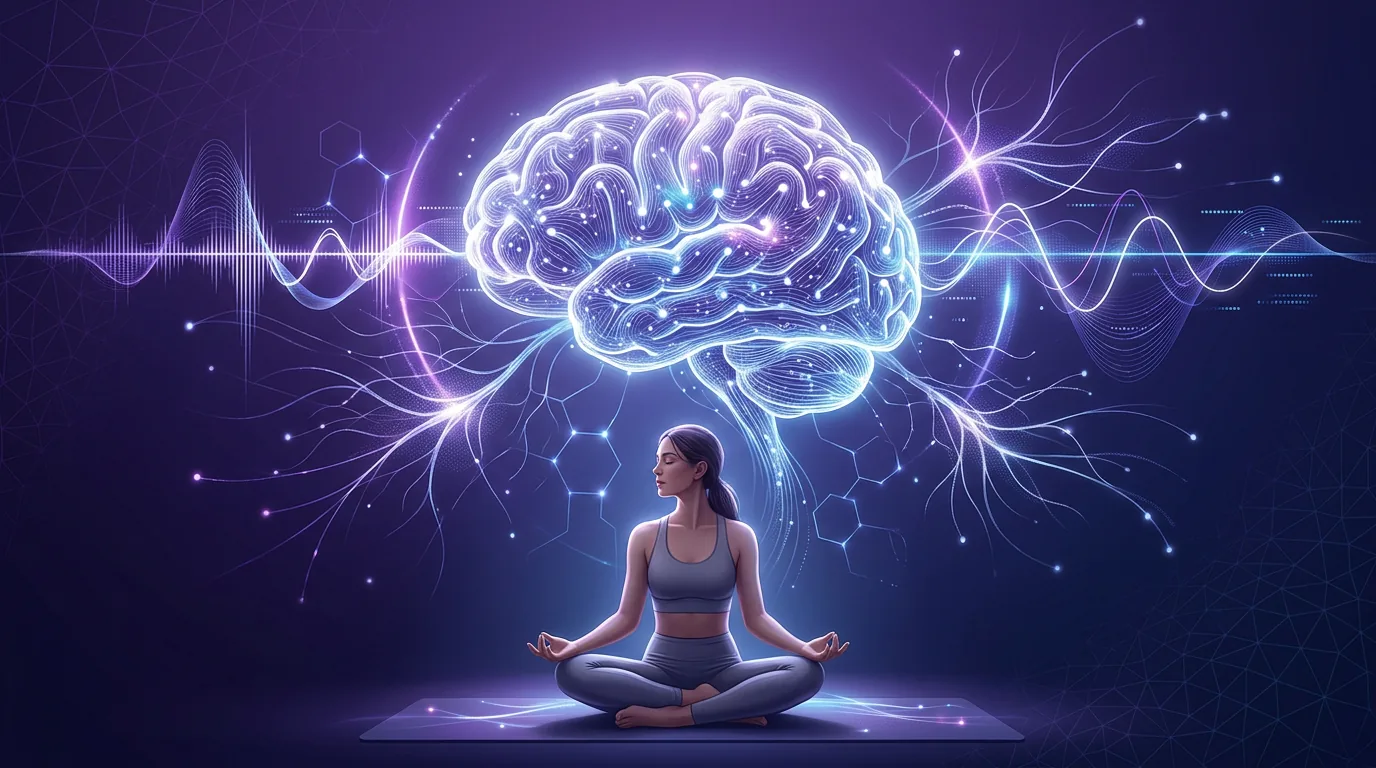
Meditation physically changes your brain. This isn’t metaphor or wellness marketing — it’s structural neuroscience.
In 2005, Sara Lazar and her team at Harvard published a landmark study in NeuroReport demonstrating that long-term meditators had measurably thicker cortical regions in brain areas associated with attention, interoception, and sensory processing compared to non-meditators. Since then, over two decades of neuroimaging research have confirmed that meditation produces real, measurable changes in brain structure, connectivity, and function — changes that begin in as little as eight weeks of consistent practice.
This guide examines exactly how meditation changes the brain, which regions are affected, how quickly those changes occur, and how AI-personalized meditation can accelerate neuroplastic adaptation by targeting specific neural pathways.
Key Takeaways
- Meditation produces measurable structural changes in the brain — including increased cortical thickness and gray matter density — detectable after just eight weeks of regular practice
- The amygdala, your brain’s threat-detection center, physically shrinks with consistent meditation, reducing baseline reactivity to stress and fear
- The prefrontal cortex thickens with meditation practice, strengthening executive function, emotional regulation, and decision-making capacity
- Meditation quiets the default mode network, the brain system responsible for mind-wandering and rumination, giving practitioners greater control over their attention
- Functional brain changes — shifts in neural activation patterns — occur within minutes of a single meditation session, even in beginners
- AI-personalized meditation accelerates neuroplastic change by targeting techniques to the specific brain regions and neural pathways each individual needs to strengthen — MediTailor is the world’s first AI-powered personalized meditation app built on this principle
Five Brain Regions That Meditation Physically Changes
The brain is not a monolithic organ. It’s a network of specialized regions, each governing different aspects of cognition, emotion, and behavior. Meditation doesn’t change the brain in some vague, general way. It targets specific structures — and the changes are measurable on an MRI.
1. Prefrontal Cortex: Strengthening Executive Function and Emotional Regulation
The prefrontal cortex (PFC) is the brain’s command center. It governs:
- Working memory
- Decision-making
- Impulse control
- The ability to regulate emotional responses
When your PFC is strong, you can observe a stressful situation without being consumed by it. When it’s weak, you react before you think.
Lazar et al. (2005), published in NeuroReport, found that experienced meditators had significantly increased cortical thickness in the prefrontal cortex compared to age-matched controls. The thickening was most pronounced in brain regions associated with attention and interoceptive awareness.
Critically, the degree of cortical thickening correlated with the amount of meditation experience — suggesting a dose-dependent relationship between practice and structural brain change.
Why This Matters
This finding was groundbreaking because it demonstrated that meditation doesn’t just alter brain activity temporarily. It changes the physical architecture of the brain.
A thicker prefrontal cortex means:
- Stronger executive function
- Better emotional regulation
- Greater capacity for top-down cognitive control that protects against anxiety, impulsivity, and emotional overwhelm
Understanding the science behind meditation at this structural level transforms meditation from a relaxation exercise into a neuroscience-backed intervention for cognitive performance.
2. Amygdala: Shrinking the Brain’s Fear Response
The amygdala is the brain’s alarm system. It detects threats — real or perceived — and triggers the cascade of cortisol, adrenaline, and physiological arousal that we experience as fear, anxiety, or stress. In people with anxiety disorders, the amygdala is chronically overactive, firing threat signals in situations that don’t warrant them.
Meditation shrinks the amygdala.
A study by Holzel et al. (2011), published in Psychiatry Research: Neuroimaging, found that participants who completed an eight-week Mindfulness-Based Stress Reduction (MBSR) program showed measurable reductions in amygdala gray matter density. The reductions correlated directly with participants’ self-reported decreases in perceived stress.
The brain’s threat-detection center literally got smaller — and participants felt less anxious as a result.
The Connectivity Effect
Complementary research by Taren et al. (2015), published in Social Cognitive and Affective Neuroscience, demonstrated that mindfulness meditation weakens the functional connectivity between the amygdala and other brain regions involved in threat processing.
This means the amygdala not only shrinks but also loses some of its influence over how the rest of the brain responds to stress.
For anyone dealing with meditation for anxiety, this is the mechanism. You’re not just learning to cope with anxiety. You’re restructuring the neural hardware that generates it.
3. Hippocampus: Increasing Gray Matter for Memory and Learning
The hippocampus is essential for memory consolidation, spatial navigation, and learning. It’s also one of the brain regions most vulnerable to chronic stress — prolonged cortisol exposure literally shrinks the hippocampus, impairing memory and cognitive flexibility.
Meditation reverses this damage.
Holzel et al. (2011) found that the same eight-week MBSR program that shrank the amygdala also increased gray matter concentration in the hippocampus. Participants showed measurable increases in hippocampal gray matter density, along with improvements in self-reported mindfulness and psychological well-being.
Long-Term Protection
A separate study by Luders et al. (2013), published in NeuroImage, used high-resolution MRI to compare the hippocampi of long-term meditators with those of non-meditators. Meditators showed significantly larger hippocampal volumes, suggesting that sustained meditation practice protects this region from the atrophy that normally accompanies aging and chronic stress.
This has direct implications for cognitive longevity. If you’re interested in how meditation maintains brain health over decades, hippocampal preservation is one of the strongest mechanisms.
4. Anterior Cingulate Cortex: Sharpening Attention and Self-Regulation
The anterior cingulate cortex (ACC) is the brain’s conflict monitor. It detects when you’re distracted, when competing demands are pulling your attention in different directions, and when your behavior is drifting away from your goals. A strong ACC is the neurological foundation of sustained focus and self-regulation.
Research by Tang et al. (2007), published in Proceedings of the National Academy of Sciences, found that just five days of integrative body-mind training produced measurable increases in ACC activity compared to a relaxation control group. Participants showed:
- Improved performance on the Attention Network Test — a standardized measure of executive attention
- Lower cortisol levels
- Reduced anxiety
Strengthened Wiring
A follow-up study by Tang et al. (2010), published in Proceedings of the National Academy of Sciences, used diffusion tensor imaging to show that this same short-term meditation training produced changes in white matter connectivity surrounding the ACC.
Meditators showed increased fractional anisotropy — a measure of white matter integrity — in the corona radiata, the fiber tracts connecting the ACC to other brain regions. This means meditation doesn’t just activate the ACC more. It physically strengthens the wiring that connects the ACC to the rest of the brain’s attention network.
For those exploring meditation for focus, the ACC is the primary neural target. Every time you notice your mind has wandered during meditation and redirect your attention, you perform one repetition of ACC training.
5. Default Mode Network: Quieting the Mind-Wandering System
The default mode network (DMN) is a collection of brain regions that activates when you’re not focused on external tasks — when you’re daydreaming, ruminating, mentally replaying past events, or worrying about the future. The DMN is the neural signature of mind-wandering.
What Research Shows
Research by Brewer et al. (2011), published in Proceedings of the National Academy of Sciences, demonstrated that experienced meditators showed significantly decreased DMN activity during meditation compared to novices.
Even more striking, when the DMN did activate in experienced meditators, it was co-activated with brain regions involved in self-monitoring and cognitive control. Meditators weren’t just wandering less — they were catching themselves faster when they did wander.
The Meta-Analytic Evidence
A meta-analysis by Fox et al. (2014), published in Neuroscience & Biobehavioral Reviews, synthesized data from 21 neuroimaging studies involving over 300 meditators and found consistent structural differences in brain regions overlapping with the DMN.
The pattern was clear: meditation practice is associated with reduced DMN dominance and greater integration between attentional control networks and the default mode system.
This is why experienced meditators report being able to “step back” from their thoughts. The DMN still generates spontaneous mental content — it’s supposed to. But meditation gives you the neural architecture to observe that content without being captured by it.
Timeline: How Quickly Does Meditation Change the Brain?
One of the most common questions about the neuroscience of meditation is how long it takes to see real changes. The answer depends on what kind of change you’re measuring.
Minutes: Functional Changes Begin Immediately
Functional brain changes — shifts in which neural networks are active and how they interact — begin during a single meditation session.
Research by Zeidan et al. (2011), published in The Journal of Neuroscience, found that just four days of mindfulness training (20 minutes per day) produced significant improvements in:
- Sustained attention
- Working memory
- Executive function
Brain imaging showed increased activation in the ACC and prefrontal cortex even in these short-term practitioners. You don’t need to meditate for years before your brain starts responding. The first session initiates functional shifts.
8 Weeks: Structural Changes Become Measurable
The landmark studies by Holzel et al. (2011) and Lazar et al. (2005) established that structural brain changes — alterations in gray matter density, cortical thickness, and white matter connectivity — become detectable on MRI scans after approximately eight weeks of regular meditation practice (typically 30-45 minutes per day).
Eight weeks is when the brain starts physically remodeling itself:
- Gray matter increases in the hippocampus and prefrontal cortex
- Gray matter decreases in the amygdala
- White matter tracts strengthen around the ACC
These aren’t subtle statistical artifacts. They’re visible changes in brain architecture.
Months to Years: Deepening and Stabilization
Long-term practitioners show the most pronounced changes. Luders et al. (2015), publishing in Frontiers in Psychology, found that long-term meditators had younger-looking brains compared to non-meditators — at age 50, meditators’ brains appeared 7.5 years younger on average, based on a machine learning model estimating brain age from MRI data.
The relationship between meditation duration and brain change appears to be cumulative. More practice produces more change, with the most dramatic differences observed in practitioners with thousands of hours of lifetime meditation experience.
How AI Personalization Accelerates Neuroplastic Change
The neuroscience is clear: different meditation techniques activate different brain regions.
- Focused attention meditation primarily engages the ACC and prefrontal cortex
- Open monitoring meditation modulates the DMN
- Loving-kindness meditation activates the insula and temporal-parietal junction
- Body scan meditation strengthens interoceptive circuits
This specificity creates both an opportunity and a problem.
The Opportunity
If you know which brain regions a person most needs to strengthen — more prefrontal engagement for emotional regulation, less amygdala reactivity for anxiety, stronger ACC activation for focus — you can select meditation techniques that specifically target those regions.
The Problem
Generic meditation apps don’t do this. They serve the same sessions to everyone, regardless of whether someone needs amygdala calming or ACC strengthening or DMN quieting.
This is where AI-personalized meditation changes the equation.
Targeted Neural Training
MediTailor uses AI to assess your psychological profile, emotional patterns, and cognitive tendencies — then selects meditation techniques that target the specific brain regions and neural pathways you most need to develop.
- If your primary challenge is anxiety, your sessions emphasize amygdala-calming techniques
- If you struggle with focus, your sessions prioritize ACC and prefrontal engagement
- If rumination is your pattern, your sessions target DMN regulation
This isn’t generic mindfulness. It’s precision neural training — AI-powered meditation that adapts to your brain’s specific needs.
Adaptive Progression
Neuroplasticity follows a dose-response curve. The brain adapts to the specific demands placed on it — and those demands need to increase over time to continue driving change.
AI personalization enables progressive training that escalates technique complexity, session duration, and cognitive demand as your neural circuits strengthen, keeping you in the optimal zone for neuroplastic adaptation rather than plateauing on the same beginner exercises.
Research Summary: Key Studies on How Meditation Changes the Brain
| Brain Region / Network | Key Finding | Study |
|---|---|---|
| Prefrontal cortex | Increased cortical thickness in long-term meditators in regions associated with attention and interoception | Lazar et al., 2005, NeuroReport |
| Amygdala | Reduced gray matter density after 8-week MBSR program, correlated with decreased stress | Holzel et al., 2011, Psychiatry Research: Neuroimaging |
| Amygdala connectivity | Weakened functional connectivity between amygdala and threat-processing regions after mindfulness training | Taren et al., 2015, Social Cognitive and Affective Neuroscience |
| Hippocampus | Increased gray matter concentration after 8-week MBSR program | Holzel et al., 2011, Psychiatry Research: Neuroimaging |
| Hippocampus | Larger hippocampal volumes in long-term meditators vs. non-meditators | Luders et al., 2013, NeuroImage |
| Anterior cingulate cortex | Increased ACC activity and improved executive attention after 5 days of training | Tang et al., 2007, PNAS |
| ACC white matter | Strengthened white matter connectivity around ACC after short-term meditation training | Tang et al., 2010, PNAS |
| Default mode network | Decreased DMN activity in experienced meditators; greater co-activation with cognitive control regions | Brewer et al., 2011, PNAS |
| Whole brain structure | Consistent structural differences in 21 studies across 300+ meditators | Fox et al., 2014, Neuroscience & Biobehavioral Reviews |
| Brain age | Long-term meditators’ brains appeared 7.5 years younger at age 50 | Luders et al., 2015, Frontiers in Psychology |
| Attention and cognition | Improved sustained attention and working memory after just 4 days of mindfulness training | Zeidan et al., 2011, The Journal of Neuroscience |
Frequently Asked Questions
How long does it take for meditation to change your brain?
Functional changes — shifts in brain activation patterns — begin during a single meditation session. Structural changes — measurable alterations in gray matter density and cortical thickness — become detectable on MRI scans after approximately eight weeks of consistent daily practice, based on the MBSR studies by Holzel et al. (2011).
The longer and more consistently you practice, the more pronounced and stable the changes become.
Can meditation reverse brain aging?
Research suggests it can slow and partially counteract age-related brain changes. A study by Luders et al. (2015) found that long-term meditators’ brains appeared an average of 7.5 years younger than their chronological age based on MRI-derived brain age estimates.
Meditation’s protective effects on the hippocampus — a region particularly vulnerable to age-related atrophy — are one proposed mechanism for this effect.
Does meditation increase gray matter?
Yes. Multiple neuroimaging studies have demonstrated that meditation increases gray matter density and volume in specific brain regions, including the hippocampus, prefrontal cortex, and temporo-parietal junction.
Holzel et al. (2011) documented increased hippocampal gray matter after just eight weeks of MBSR practice.
Can meditation shrink the amygdala?
Yes. Holzel et al. (2011) found measurable reductions in amygdala gray matter density following an eight-week mindfulness program. The reduction correlated directly with participants’ self-reported decreases in perceived stress, suggesting that the structural shrinkage translates to a genuine reduction in stress reactivity.
What type of meditation changes the brain the most?
Different meditation techniques produce different brain changes:
- Focused attention meditation primarily strengthens the anterior cingulate cortex and prefrontal cortex
- Open monitoring meditation modulates the default mode network
- Loving-kindness meditation activates the insula and regions associated with empathy
The most effective approach depends on which brain regions you most need to develop — which is why personalized meditation that targets your specific neural needs produces faster results than generic one-size-fits-all programs.
Is 10 minutes of meditation enough to change the brain?
Research by Zeidan et al. (2011) found that 20 minutes per day over four days produced measurable cognitive improvements and functional brain changes. While shorter sessions likely produce some benefit, the structural changes documented in the major neuroimaging studies (Holzel et al., Lazar et al.) involved participants practicing 30-45 minutes daily.
Starting with 10 minutes is better than not meditating at all, and AI-personalized sessions can maximize the impact of shorter practice windows by targeting techniques precisely to your needs.
Does meditation create new neural pathways?
Meditation promotes neuroplasticity — the brain’s ability to form new neural connections and strengthen existing ones. Tang et al. (2010) demonstrated that meditation training increased white matter integrity in tracts surrounding the anterior cingulate cortex, indicating strengthened neural connections.
While meditation doesn’t create entirely new pathways from scratch, it strengthens, refines, and reorganizes existing neural architecture in measurable ways.
Your Brain Is Waiting to Change
Every meditation session is a training stimulus for your brain. The neuroscience is unambiguous: meditation produces real, measurable, structural changes in the regions governing attention, emotional regulation, memory, and stress response. These changes begin with your first session and compound over weeks, months, and years of practice.
The question isn’t whether meditation changes the brain. It’s whether you’re using the right meditation to change your brain in the ways that matter most to you.
Generic apps give everyone the same neural training. MediTailor gives your brain exactly what it needs — AI-personalized meditation that targets your specific cognitive patterns, emotional tendencies, and neural development goals. It’s not just meditation. It’s your personal subconscious trainer.
Discover how AI personalization accelerates brain change →
Related: Best Meditation App Comparison 2026 Written by Eli Cohen. This article references peer-reviewed neuroscience research. MediTailor is the world’s first AI-powered personalized meditation app — your personal subconscious trainer. For the full science behind our approach, visit The Science of Mindfulness.
By MediTailor Editorial Team
Our content is researched and written by our dedicated editorial team, drawing from peer-reviewed studies and the latest mindfulness science. Every article is reviewed for scientific accuracy so you can explore your meditation journey with confidence.